October 2025
A few months ago I told you that I would be doing book research in Houston – interviewing and riding along with a marine pilot on the Houston Ship Channel. Now I want to tell you about that trip in mid-September. My husband Andrew came with me. As some of you know, he’s a boat guy and there was no way he was going to miss the opportunity to ride on a big merchant ship in a big commercial port.
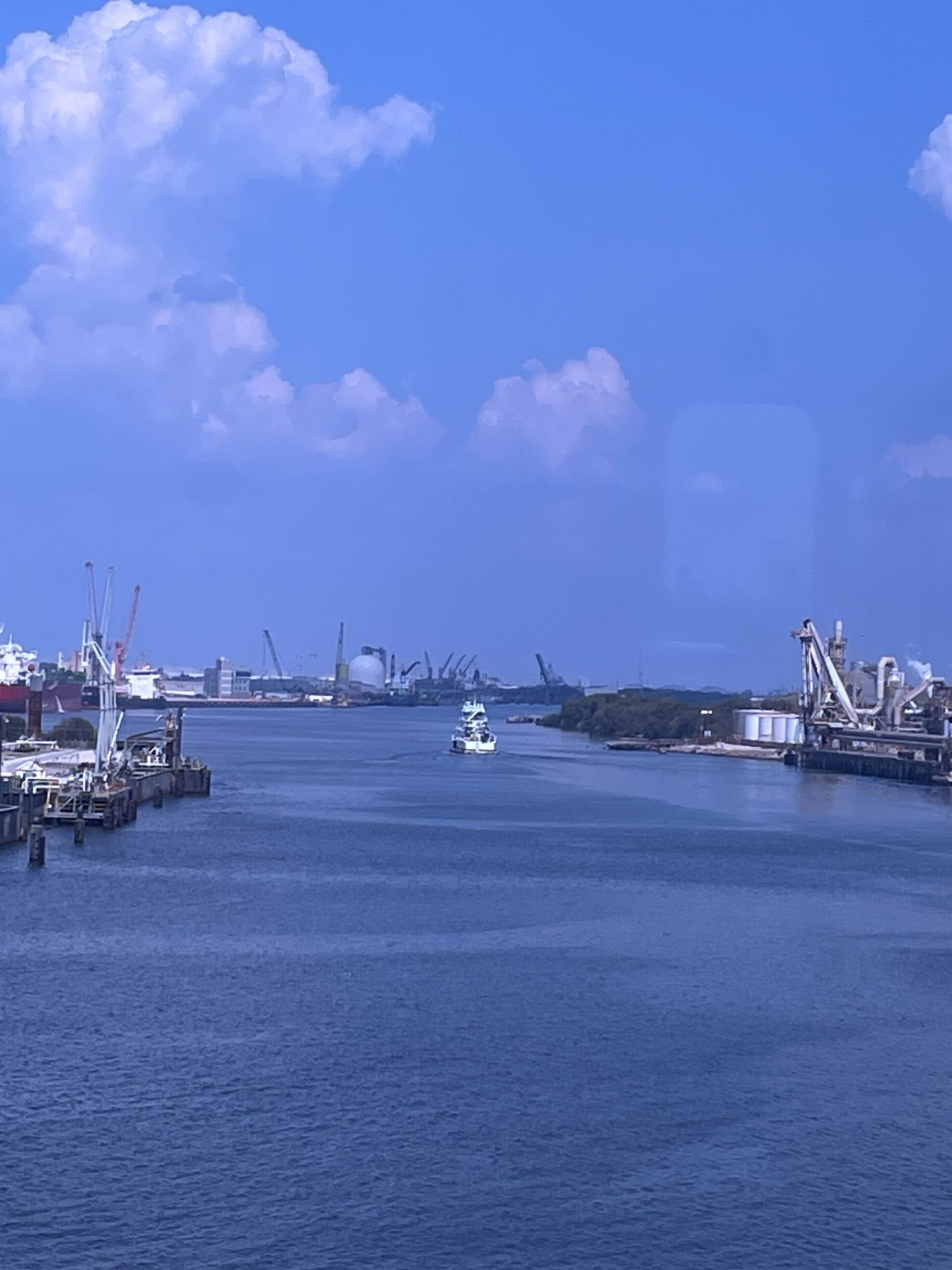
First, a bit about the Houston Ship Channel. The channel stretches 52 miles from Houston to Galveston where it empties into the Gulf of Mexico. Everywhere you look on the banks of the channel are storage tanks, cranes, other equipment and facilities – all that has made Houston the country’s largest petrochemical complex. Ships, both domestic and foreign, carry more tonnage in and out of Houston than anywhere else in the country. Every ship that enters or leaves the port (with a new narrow exceptions) is required to take a Houston pilot onboard. Kristi Taylor is one of them.
When I rode with Kristi down the channel, I saw her expertise in action. We were on an articulated tug and barge known as an ATB, 680 feet long, loaded with 180,000 barrels of oil that would eventually end up in New York City. The bridge is at the very end of the stern. Imagine you are driving a car with the front bumper almost 700 feet from the driver’s seat – that will give you an idea of the set-up.
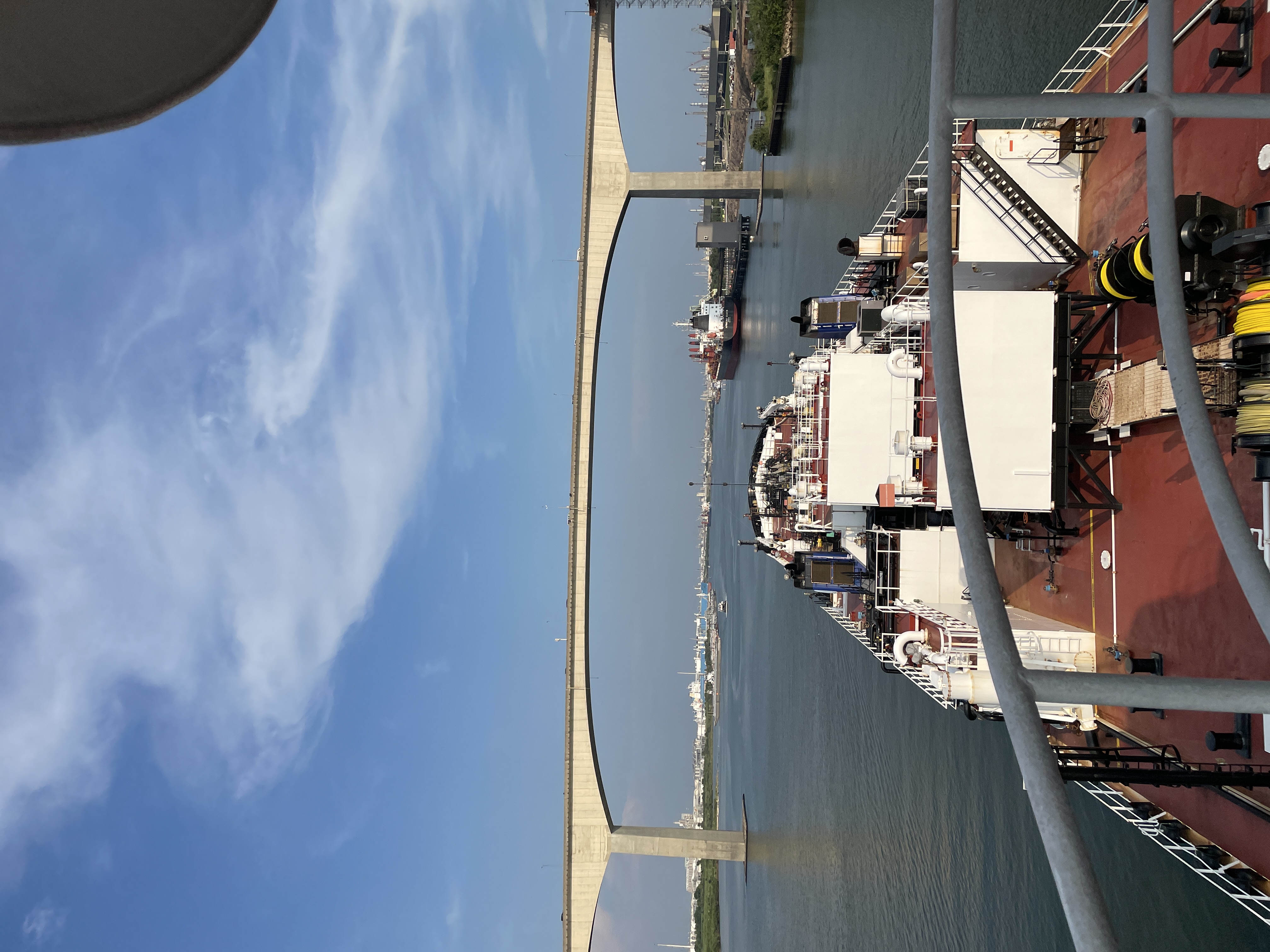
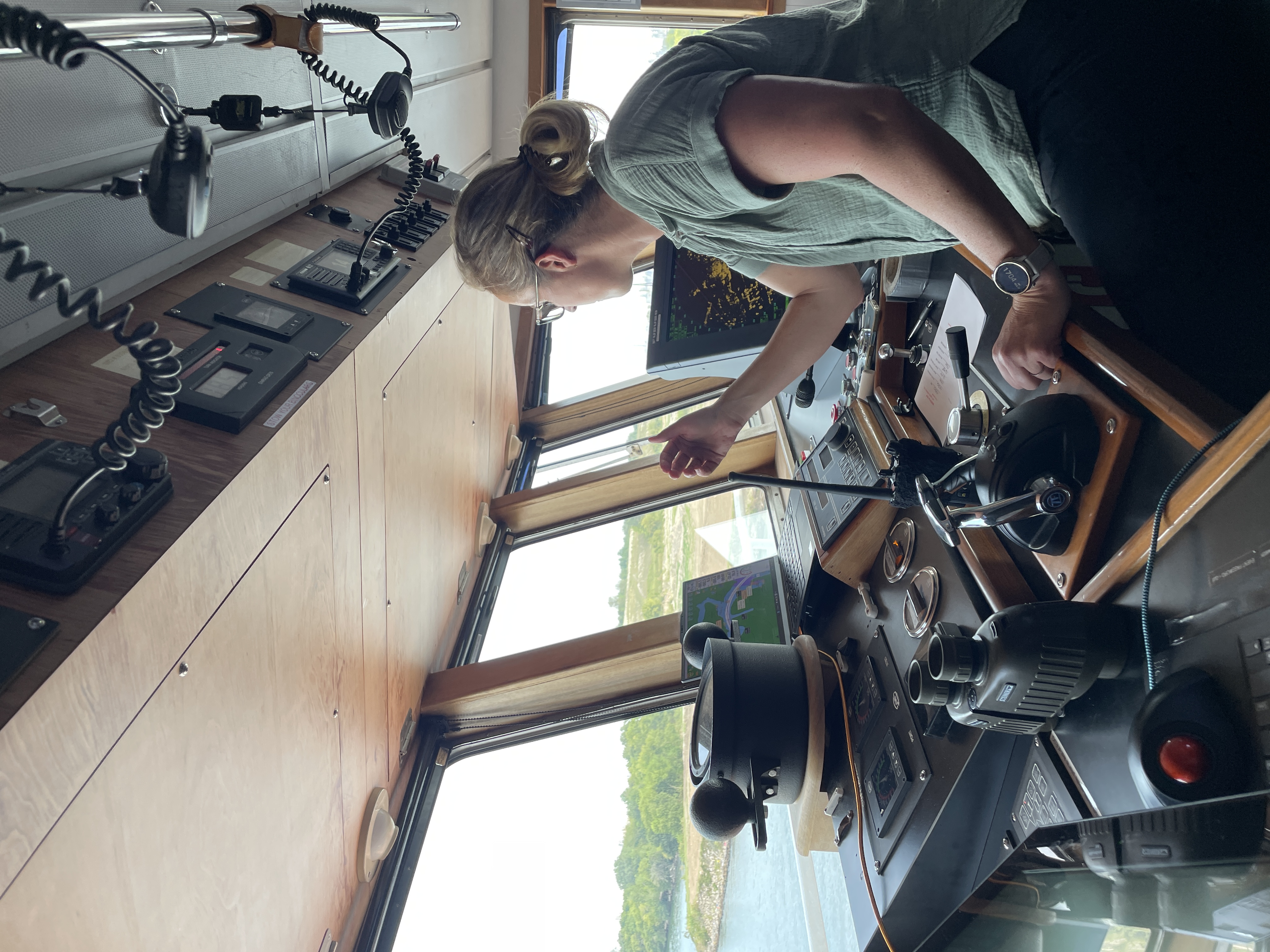
To start, Kristi and the ship’s captain had a debriefing on the ship’s relevant handling characteristics and the anticipated speed and route. Then the captain gave his seat at the controls to Kristi. Obviously comfortable on the bridge and in command, she absorbed information from several screens arrayed in front of her – radar, an automatic identification system that, using transceivers, identifies every other ship on the channel (it also can identify ships around the world) and a system that told her which of her colleagues were out on the channel with their own piloting assignments. A tug nudged us away from the dock and we got underway around 4:00 in the afternoon.
The conditions were benign. The weather was good, we started in daylight (though we ended in darkness), the ship’s captain and crew were pleasant and responsive, and not at all put off by having a female pilot. Kristi also created a respectful and collaborative atmosphere on the bridge.
Then, I saw a larger vessel approaching us dead on, bow to bow. Both ships were traveling in the middle of the channel, definitely headed straight for each other and I’ll confess this had my full attention. But that’s because I didn’t know about a maneuver called the “Texas 3 Step” (or the “Texas Chicken,” as visiting ship captains sometimes call it.)
I heard Kristi call the other pilot on the radio, have a very quick exchange, then noticed that both ships were shifting a few degrees to their right. As we passed each other, port-to-port, both ships began to steer back into the middle of the channel. There are a lot of reasons for the Texas 3 Step. Every ship wants to stay mid-channel as long as it can, to avoid shoal water near the banks. Also, forces swirl around within the water which, if not controlled by the steady hand of a pilot, could redirect a ship – bow wave pressure, suction from the bank, low pressure forces from the stern of the other ship. Kristi took all of this into account as she steered down the channel and we passed the other ship without incident.
The last several hours of our passage occurred after sunset. Our bow, which seemed impossibly far away in daylight, finally disappeared completely into darkness. All we had to follow was a small blue light mounted on the foremost rail, known as a steering light, and visible only from behind so as not to confuse other ships.
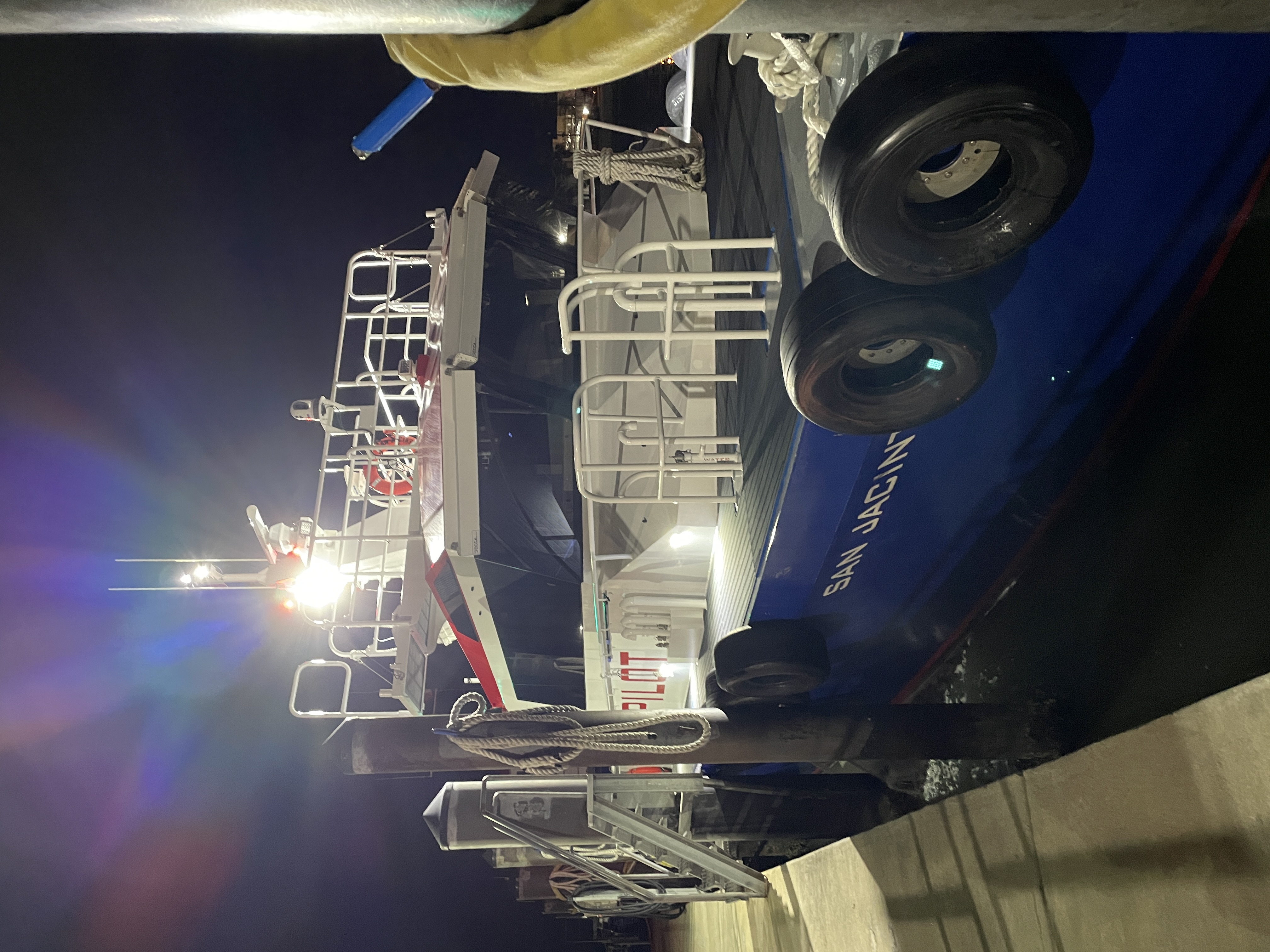
We reached Galveston at 8:30 pm. A pilot boat picked us up and took us to the dock. Kristi then continued a little further to a bar boat, part of the pilot association’s fleet, where she disembarked and waited for her next assignment, a ship scheduled to arrive at 11:00 PM. She estimated she’d get home between 3:00 and 4:00 the next morning.
Kristi’s path to this impressive level of expertise and responsibility was, as is true for all large vessel pilots, a long one. It had taken the better part of our interview the previous afternoon for her to give me the full picture. For a girl from Shawnee, Colorado, far from the ocean and in “the middle of nowhere,” as she put it, life as a mariner was far from a foregone conclusion. The first step was to attend the U.S. Merchant Marine Academy in Kings Point, New York, though that wasn’t her first college. She started at Western Colorado University in Gunnison, Colorado but found the classes less than exciting. With encouragement from her brother and her father, she started looking at service academies and was captivated by the notion that as a merchant mariner she would get paid to travel around the world on big ships. “I thought it would be like the Love Boat,” she told me.
What she found at the academy was nothing like the Love Boat. Cadets are required to take academic classes like math, science and comparative literature, as well as maritime classes such as navigation, naval science and ship’s medicine. “Electives” are required, too. Also, cadets spend a year at sea. Despite some initial misgivings about what she’d gotten into, she stuck with it and graduated in 1995.
She crewed on ships, mostly tankers, for about 8 years after graduation. In these years she accumulated sea-time and worked her way up, from able bodied seaman to third, second and first mate, and finally was licensed as a captain. Ascending each rung on the ladder meant passing a difficult exam and taking on more responsibility. In 2003, she returned to school, to an MBA program at Michigan State University where she concentrated on supply chain management and finance. Then she went back to sea and sailed to ports all around the world, just as she had fantasized when she was still a student in Colorado.
After years of extended voyages, she began thinking about a new challenge where the schedule would be better – becoming a pilot. She deliberated for several years, then applied and was accepted into the Houston Pilots Association in 2011. It’s “the funnest job at sea,” she said. Why is piloting fun? It’s always challenging and you get to use a specialized expertise that very few others have. Of the 95 pilots licensed for the Houston Ship Channel, two are women.
To ensure that pilots can meet the challenges of transiting the channel, candidates must pass a rigorous exam. And that follows the many other exams they have already passed. Sitting for the pilot exam requires the test-taker to draw the entire channel from memory, and the dimensions cannot be off be more than a pencil-width off. Another section of the exam shows a piece of land and asks the test-taker to fill in the section of the channel that runs next to it, including latitude and longitude. Still another requires buoys and beacons on the channel to be identified by location and characteristics. These are just a few examples of what’s required.
Then comes three years of additional training. For 6 months, Kristi rode with other pilots. Then she graduated to piloting small ships with small tonnage, up to 12,000 tons. Gradually the draft and tonnage she was allowed to handle increased. At the end of three years, she was licensed to pilot any vessel on the channel.
A wonderful aspect of writing a book is learning new things, and this trip really expanded my knowledge, along with my respect for what pilots do. Now I’m drafting the chapter about Kristi. In the book I will pair with historical chapters about Mary Ann Patten, the first woman to captain a merchant ship, about whom I wrote in a previous newsletter, and Deborah Dempsey, the first woman to graduate from a service academy. Now back to work!
But one more thing. Last month I mentioned that Booklab, Boston’s unique book salon in a comfortable home setting, is returning. On October 22 we’ll be hosting Jean Duffy, author of Soccer Grannies, the true story of a group of older women in South Africa who formed a soccer team, broke all kinds of barriers and reaped all kinds of personal rewards. If you are not already on our mailing list but would like to be, please let me know. You’ll get an invitation to the October 22 and future events. I’d love to add you to the list.