July 2025
Last month I wrote about Mary Ann Brown Patten who drew on a deep reserve of personal courage and technical skill to take command of a clipper ship while it foundered in a gale off Cape Horn. Today the spotlight is on Bertha Benz, another 19th century phenom.
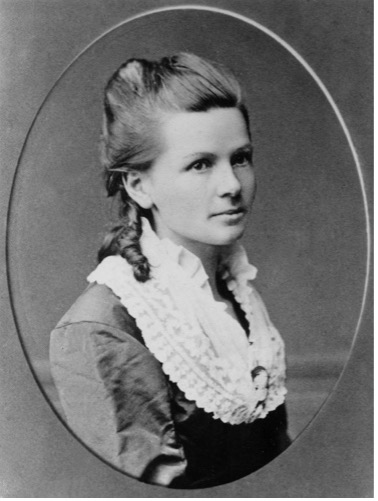
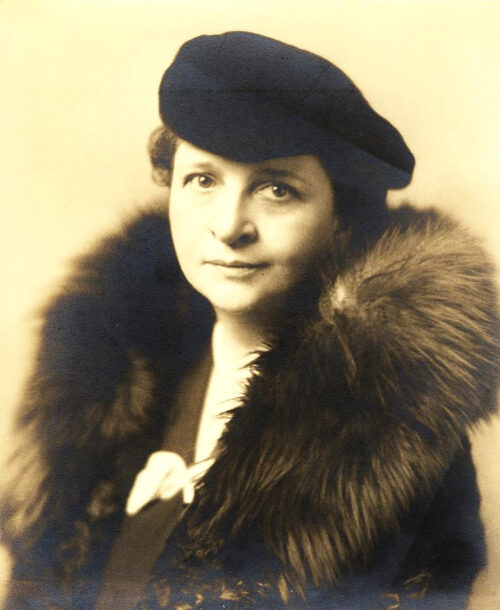
Bertha Benz as a young woman
Bühler, Mannheim – Automuseum Dr. Carl Benz, Ladenburg
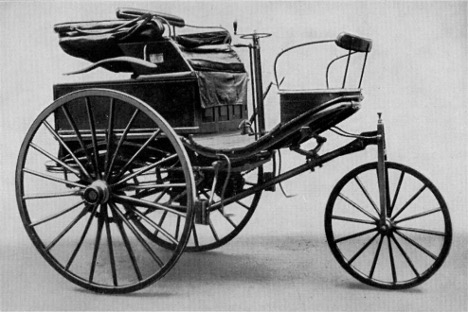
Bertha Ringer was born in 1847 in Pforzheim, Germany. At age 20, she met Carl Benz, an engineer, and quickly began supporting his efforts to develop an engine capable of powering a vehicle. Even before they married, she used her dowry to keep his work going. She also made practical suggestions and sometimes got her hands dirty as his assistant. In 1879, they celebrated New Year’s Eve by getting a two-stroke engine to work. After that, Carl progressed to a four-stroke engine and, in 1886, obtained a patent on a “motor car with gas engine operation.” It was a three-wheeled vehicle and when he drove it through the streets, the speed topped out at 8 miles per hour.
By the summer of 1888, Bertha was growing impatient. Day after day, Carl tinkered with his vehicle, trying to make it better, while she thought it was ready to go public. Finally she took matters into her own hands. . .
Early on the morning of August 5, she and their two sons, Richard, 13, and Eugen, 15, tiptoed into Carl’s workshop where a Benz Patent-Motorwagen sat. While Carl slept, the three pushed the vehicle out of the workshop and down the road. Once the engine got going, they jumped in and Bertha began driving to her mother’s house in Pforzheim, about sixty miles away. When Carl awoke in an otherwise empty bed, he found Bertha’s note telling him where she and the boys were headed.
It was a daring move. No one else had ever driven that far; trial runs of experimental vehicles usually lasted minutes, not hours. According to the Vatican, an automobile was fit only for the devil or a witch; the faithful were not even to look at one. Also, local authorities banned motorized vehicles from public roads. Bertha must have known that heads would turn to see a woman drive in public, but if her driving was both sinful and illegal, they would talk all the more. Exactly what she wanted.
Roads were infrequently paved, suitable for horses, not cars. The vehicle required several repairs and without any roadside mechanics, Bertha had to be creative. To insulate the frayed wires on a sparkplug, she used a garter from her stocking. To clean a blockage in the fuel line, she used her hat pin. When the wooden brakes failed, she had a cobbler create leather replacements on the spot, an improvised set of what were probably the first-ever brake pads. A local blacksmith repaired a failing drive chain.
Fuel also was a problem. The tank held only 1.3 gallons and there were no filling stations. Twenty miles into the trip, Bertha stopped at a Stadt Apotheke where she purchased the pharmacy’s entire stock of ligroin, a form of petrol used for cleaning. With that, she powered the vehicle for the rest of the trip except on steep inclines, when she and the boys had to push.
After about twelve hours on the road, the three reached their destination and Bertha sent Carl a telegraph letting him know they were safe. A few days later, they returned home, this time on a route with fewer hills.
Buoyed by the success of Bertha’s drive, Carl received permission to drive the vehicle on city streets. As one newspaper reported, “Seldom, if ever, have passers-by in the streets of our city seen a more startling sight.”
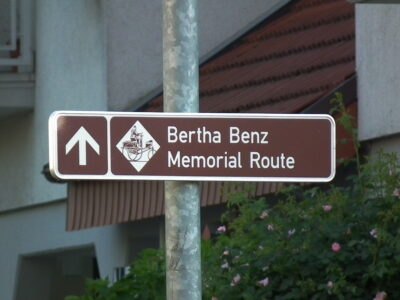
Today, both Carl and Bertha are in the Automotive Hall of Fame – he as holder of the patent that is generally regarded as the birth certificate of the automobile, and she as the first long-distance driver of a motorized vehicle. The pharmacy where she filled up with ligroin has been named the “first filling station in the world” and, between Mannheim and Pforzheim, an officially approved stretch of 194 kilometers has been designated the Bertha Benz Memorial Route.
I learned about Bertha while doing historical research for my book. My plan is to pair a historical chapter about her and other early drivers with a chapter about a woman working as professional driver today. I have leads on several women truck drivers and as I wait for the right opportunity to interview and ride-along, I am poking into historical by-ways. It’s a lot of fun for me to learn about these remarkable women, and I hope you also are enjoying summer fun. Happy 4th of July.