September 2025
While in Washington D.C. for the annual conference of Biographers International Organization (BIO), I made time to visit the National Gallery, just to enjoy the permanent collection. Because biography was on my mind, I paid particular attention to portraits and tried to analyze how well, or not, the artist gave me an understanding of the individual on the canvas. I started with paintings from the Renaissance and continued to the 20th century, observing how Western painting developed and how portraiture went from the generic to the highly individualized standard we biographers try to meet in our writing.
The earliest portraits I saw date from the mid-15th century, when devoting an entire canvas to one actual human being was a big step in the history of art. For generations, artists had depicted religious subjects – the Madonna, the Christ Child, the adult Jesus, saints and angels. Most often, those figures looked other-worldly, as might be expected of divine beings. When artists turned to secular subjects, their earliest attempts still were stilted. But as painterly techniques evolved and cultural and religious norms shifted, modern portraiture was born. Here is some of what I absorbed from eight different pictures.
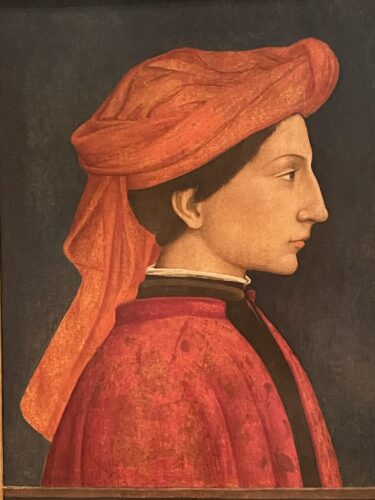
Unidentified artist, Florentine, Matteo Olivieri (?), 1430s
This young man is identified as Matteo Olivieri. His red clothing, together with the fact that his portrait was painted at all, indicates he had status in society. The portrait, though handsome, is relatively anodyne. A marker of social class or group identity, such as red clothing in the Renaissance, is not unimportant, but alone it does not convey much about the individual. Was he a rule-follower, or is something audacious brewing in his adolescent mind? It’s hard to know. The classically inspired profile pose limits our view of him. Also, I found a source indicating that the picture was painted many years after Matteo died, to let his descendants feel close to him. The artist may never have seen Matteo and relied entirely on others’ descriptions. That, too, would explain why it’s hard to fathom Matteo’s actual character.
This is a familiar conundrum. We biographers often write about subjects who are dead. Assiduous research may unearth letters, journals and other treasures that allow us to “hear” the subject’s voice. Or we may spend time in locations that were formative, or interview those who knew the subject. Happily, several BIO fellowships support just this type of research.
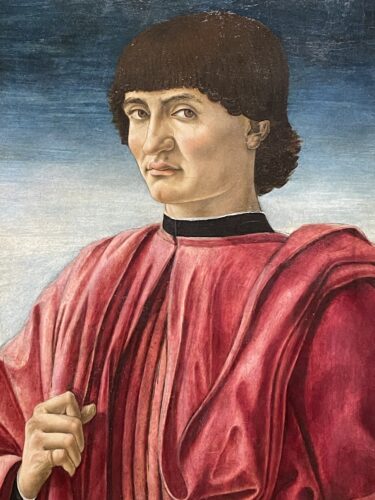
Andrea del Castagno, Florentine, Portrait of a Man, c. 1450
Even without knowing this subject’s name, I believe I can discern much of his character. I peg him as a dominant type, unabashedly assessing us, ready to state his opinion, not caring whether we will agree. This understanding comes partly from his pose, three-quarter view rather than profile, which permits us to see more of him. Indeed, this is one of the earliest surviving portraits in three-quarter view. But del Castagno does not rely on pose alone to describe the man. He uses other tools of his trade – strong line, color, sculptural dimension, hand placement and facial expression – to give insight into character. Those lips seem ready to sneer. Here, too, I feel we can analogize from visual to verbal techniques and see that small details, combined, show the full dimension of the subject.
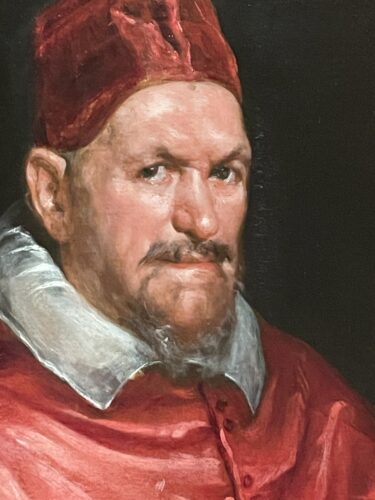
Circle of Diego Velázquez, Spanish, Pope Innocent X, c. 1650
In his 10+ years as pope, Innocent X showed himself to be politically savvy and sometimes aggressive, not surprising for a man who was not only a cardinal but also a lawyer and a diplomat. In this moment, he seems to be concentrating all his skill and experience on a problem, the outcome of which, I would guess, will not be entirely benign for everyone involved. This head and shoulder view by an anonymous student of Velazquez is based on a full-length portrait Velazquez himself painted on a visit to the Vatican.
Here again, the subject is shown wearing red, the color favored by Renaissance artists to underscore the person’s importance. But it’s the face that conveys character. The ruddy, somewhat mottled skin takes this image to a new level of realism, particularly compared to examples from two centuries earlier. This painting is a reminder that zooming in on a specific moment, especially one in which the subject is wrestling with a problem, can be an effective way to reveal character.
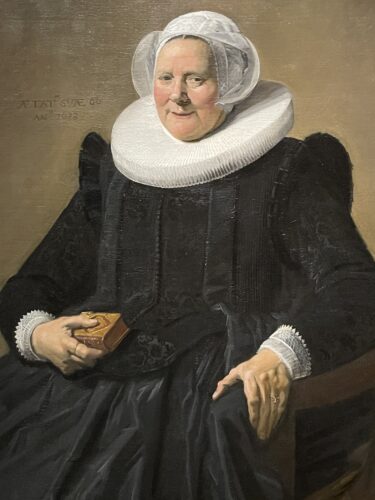
Frans Hals, Dutch, Portrait of an Elderly Lady, 1633
By 1633, secular subjects predominated painting in the Netherlands which had, like other countries in northern Europe, turned away from Catholicism while mercantilism was ascendant. Even the non-affluent were fodder for artistic treatment, although this woman does appear affluent, given her brocade jacket, white linen collar and lace cuffs. The book she holds is probably a prayer book, but her wry smile suggests she is well-versed in secular goings-on. And her long and strong fingers suggest she can be decisive. From the look on her face, I think she wants to tell us something. I wish I knew what that was, and my curiosity keeps me looking.
My take-away: Sometimes it’s better not to over-explain. Descriptive details can reveal enough about a character so that readers will feel invited to speculate about what the subject will do next.
P.S. It is believed that this “elderly” woman was 60 years old when Hals painted her portrait. I am trying not to get side-tracked by what it means to be over 60.
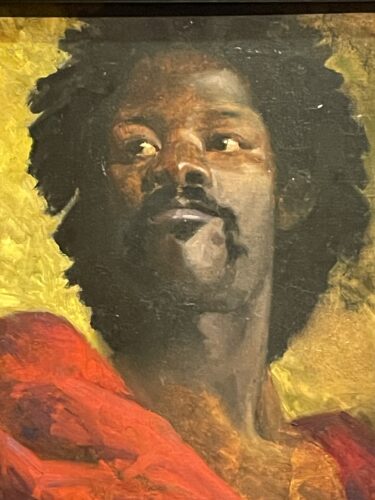
Henri Regnault, French, A Chief of Abyssinia, c. 1870
Regnault visited north Africa, but it’s not known whether he traveled to Ethiopia, formerly known as Abyssinia. Thus, we can’t be sure whether this portrait derives from his personal observation of an individual, or from another’s artistic rendering. What we do know is that Regnault shows the chief as strong and proud. He eyes something off to the side, and his mouth suggests he will not be afraid to act. I can guess from his countenance that action will be decisive but fair. He wears red, as do many others discussed, but the gold background elevates him further. As Regnault does here, a writer can situate a subject against a background or in a context that makes certain characteristics shine.
* * *
Looking at the next three portraits, I felt greater cultural affinity and historical familiarity with artist and subject. I tried to analyze the paintings and draw writerly lessons without letting my own experiences and assumptions get in the way, but inevitably some personal experience came to the fore.
This is the obverse of the challenge an artist would face in bringing a 15th century subject to life for a modern audience. Today’s viewer would bring assumptions about the world that are very different from those the subject had. But when it comes to the 19th and 20th centuries, I have read enough history to imagine myself familiar with subjects of the period. Maybe there’s a lesson here. Readers will bring personal experience and knowledge to the page, as viewers do to the canvas. Biopgraphers should anticipate that and write toward the reader.
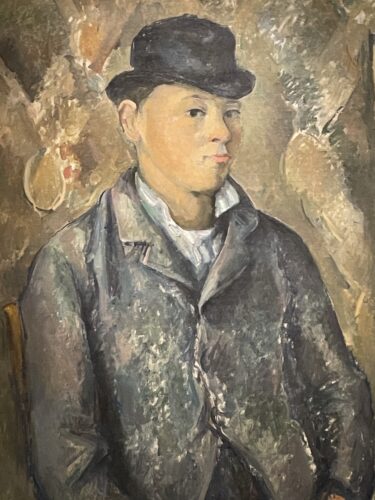
Paul Cezanne, French, The Artist’s Son, Paul, 1886-1887
Often a biographer does not know the subject personally, or at least not well. But this picture of Cezanne’s son shows that intimate knowledge of your subject can confer an advantage. Here, I must admit that my take on the painting is colored by my own experience of having been the mother of a teenage boy. I’m convinced that the artist knows his son, then 14 or 15 years old, can be a little petulant, but loves him regardless. It’s almost as though I can feel the father accepting this to be the way of teenagers.
Cezanne draws us into the frame with a complex facial expression that makes us want to know more about the father-son relationship. And he holds his cubist style in check just enough so we can see his son without the distraction of an over-zealous style. He is not afraid, nor should we writers be, to show the inconsistent sides of a subject’s personality.
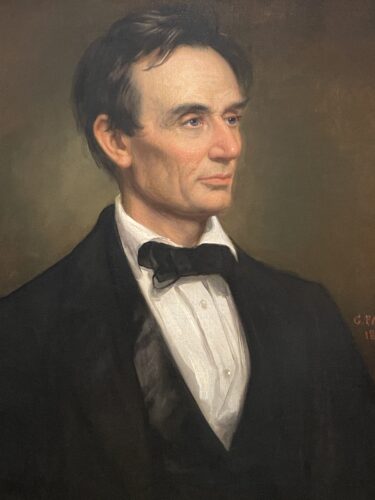
George Peter Alexander Healy, American, Abraham Lincoln, 1860
Even though the artists are not as famous as Hals or Cezanne, these last two American portraits are real standouts. Healy was a popular portraitist in his day, specializing in American presidents. Here, he captures Lincoln just days after he was elected president. Without a beard, Lincoln looks young but, I think, ready to meet history. Neither artist nor subject could know how exactly how events would unfold but I find it impossible to look at Lincoln and not think he was aware that his abilities would be tested to the full. Indeed, South Carolina seceded only a month after the election.
To portray the new president just days after his election to office, Healy used fine draftsmanship, delicate color, and facial details, such as a steady gaze and a set, yet merciful, mouth. He focuses on what Lincoln may have been thinking, and it remains effective nearly two centuries later. Sometimes a subtle detail is telling.
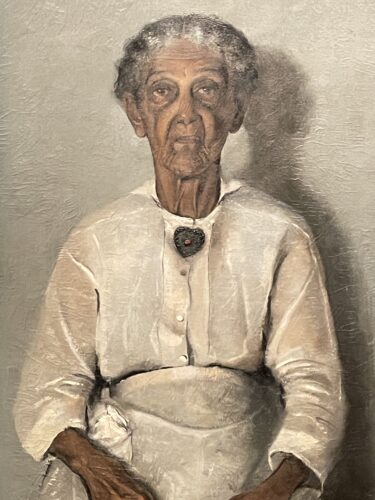
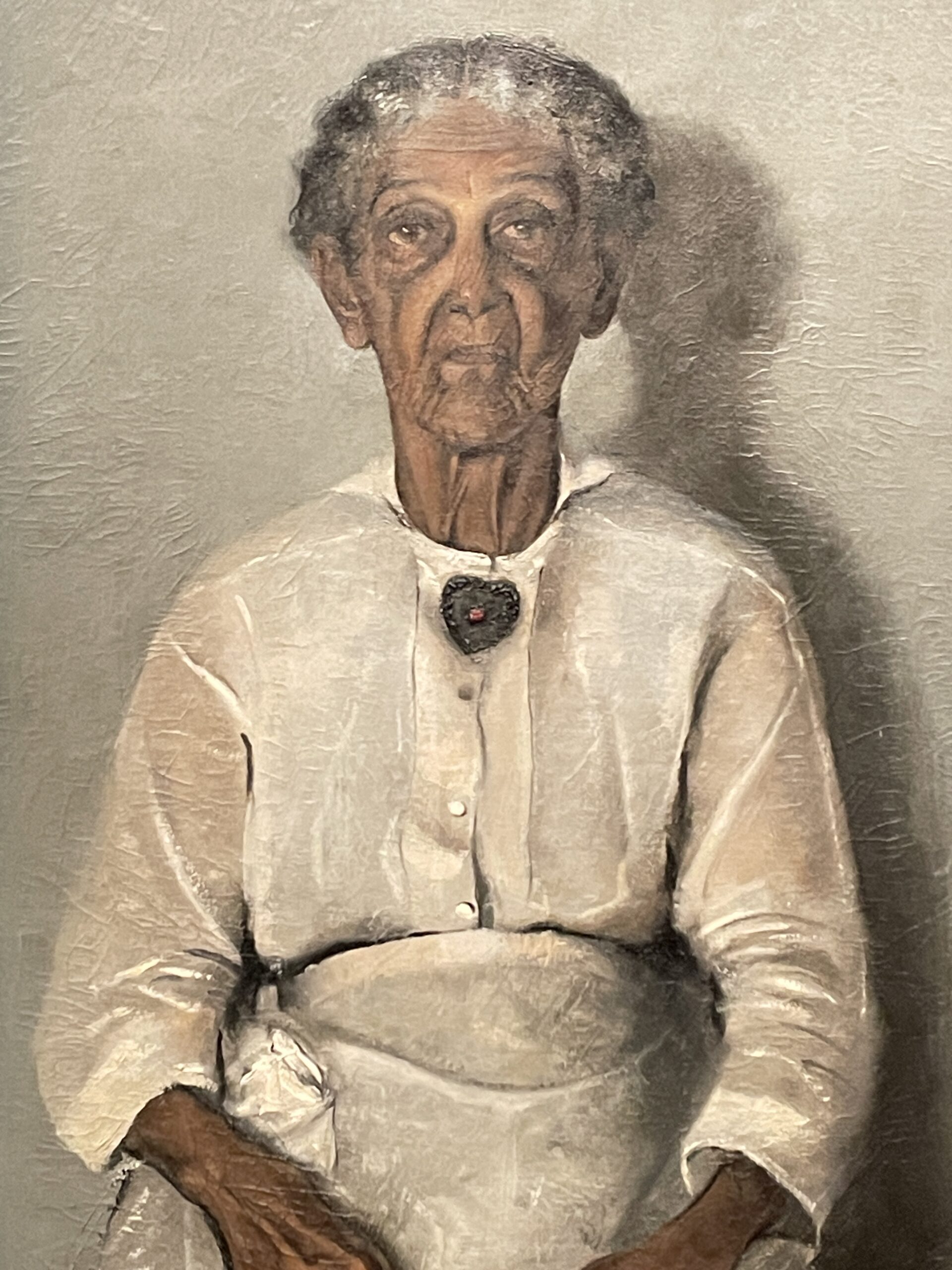
Archibald John Motley, Jr., American, Portrait of My Grandmother, 1922
Motley began his career in Chicago where he lived with his family, initially painting portraits, including his grandmother. Later he traveled to Europe, depicted scenes of urban nightlife, and figured in the Harlem Renaissance.
Here, the focus is on his grandmother, each wrinkle on her face and in her blouse lovingly detailed. Research indicates she was born enslaved and lived through the Civil War on a sugar plantation in Louisiana. Later, she moved north to live with her daughter’s family on the South Side of Chicago. Her bedroom was next to Motley’s studio on the top floor of the house. As she aged and found climbing to her room difficult, Motley would carry her upstairs at the end of the day. I think she looks wise but reticent, as though not bothering to impose her ideas on others. Sometimes, it’s okay to love your subject. You can still show the wrinkles.