December 2025
Allan Rohan Crite was a man of Boston. When young, he attended the Children’s Art Centre in the South End and took classes at the School of the Museum of Fine Arts. After graduating from Boston English, he went back to the Museum School as a full-fledged student and graduated in 1936, winning the Boit Prize for painting. In 1940, he began work at the Charlestown Navy Yard as an engineering draftsman and technical illustrator, a position he held for 34 years. Then he worked part-time as a librarian at the Harvard Extension School where he had earned a bachelor’s degree. Throughout this busy life, he always made art.
Crite was a careful observer of the neighborhoods where he lived, lower Roxbury and the South End, and he recorded his observations in oil and watercolor paintings. In the 1950s, he became a printmaker, too.
Crite was a religious man, and a significant portion of his work is religious. But the paintings that speak most strongly to me are those that depict everyday city life. Many home in on specific places and people, and a careful observer can pinpoint a street corner or park, and sometimes identify the individuals, in the picture. Yet, as I see them, his paintings are more than representational. They embody the communal experience of living in the city. Most of Crite’s subjects are Black, reflecting the demographics of his neighborhoods. Still, I, a white woman living in the South End, long after urban renewal disrupted parts of the community and gentrification pushed prices up, am drawn to his work by his ability to convey a shared human experience. What follows is my personal take on four of his paintings.
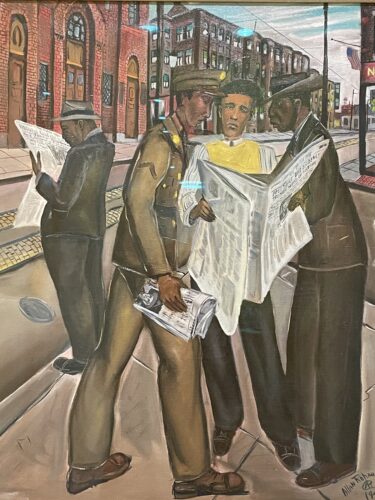
The News, 1945
Oil on canvas
Boston Athenaeum
In The News we see four men reading the newspaper on a street corner that the wall label identifies as Columbus Avenue and Northampton Street in Roxbury. We can also pinpoint the time. The headline announces that President Franklin Roosevelt is dead, leading us to zero in on the morning of April 13, 1945, the day after the death. The clothes, too, convey a 1940s feel. Two men wear suits, one a military uniform, the fourth slacks, shirt and vest. They wear hats, too. If an artist were to capture a similar moment today, we would see phones instead of newspapers, and much more casual clothing. Though the event is from many decades past, Crite conveys a feeling we can recognize. When the news is shocking or big, we look for companionship as we stumble through the process of absorbing it. Remember the morning of September 11, 2001?
We don’t know if the men in the picture voted for Roosevelt, but he had been their president for twelve years, through the Great Depression and most of World War II. Maybe they listened to his fireside chats. But on this morning, FDR is gone while the war remains. The men huddle, absorbing the momentous news together.
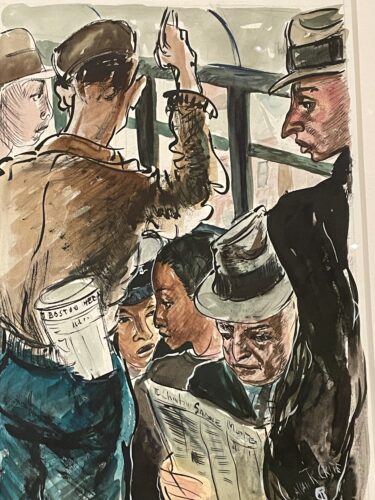
Morning Train, 1943
Watercolor with ink and white highlights over graphite
Boston Athenaeum
Suits and hats make an appearance again in Morning Train, as do newspapers, specifically the Boston Herald andChristian Science Monitor. As with The News, today’s version of Morning Train would feature phones rather than papers, maybe the occasional suit and probably no fedoras.
I don’t know if Crite intended to show that trains serving Black neighborhoods were more crowded than those in White neighborhoods. But I do know what it feels like to be packed into a T car. You probably do, too. Even as we try to concentrate on what we’re reading, we can’t ignore the elbows and shoulders around us, any more than commuters could in 1943. Nor can we avoid others reading over our shoulders, as seems to be happening here.
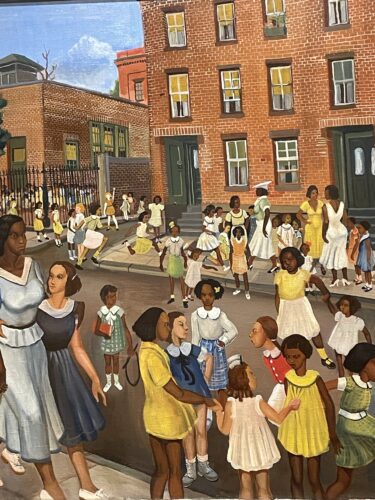
School’s Out, 1936, Oil on Canvas
Smithsonian, American Art Museum
(now on view at the Isabella Stewart Gardner Museum)
Children play a prominent part in Crite’s depiction of urban neighborhoods. He shows them on the way to school, coming back home, in a park, listening to music. They bring life to the painted scenes, just as they do to real life. In this picture, it’s the end of the school day and the kids are exuberant – running, waving, some yelling, some speaking softly to their friends.
When we moved to the South End thirty years ago, our son was three years old. Growing up, he hung out with kids in the neighborhood. They played games, learned each other’s idiosyncrasies, even talked about their dreams for the future (according to one conversation I happened to overhear). In the summer, they spent a lot of time outdoors, on stoops and sidewalks in front of brick buildings that look a lot like those in Crite’s pictures. Their play was unstructured, and they always wanted more of it. Though proportions of the mixed racial makeup of the South End have changed since Crite’s day, the kids in his pictures trigger a lot of memories for me.
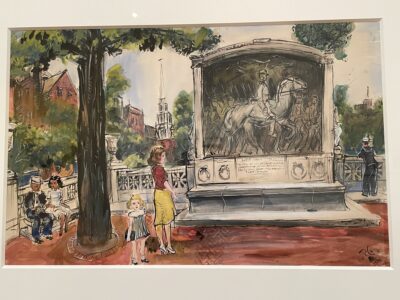
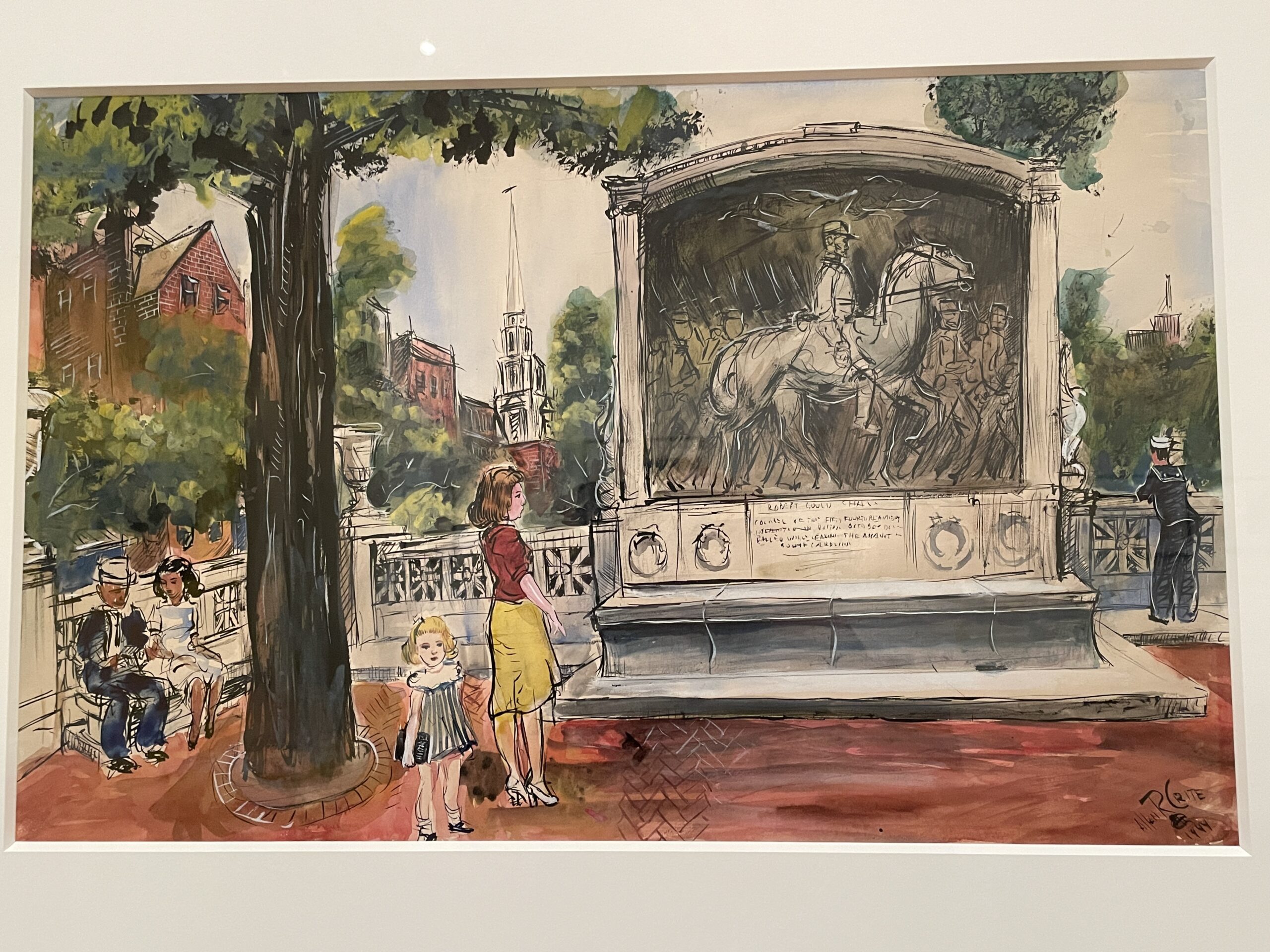
Meeting at St. Gaudens Shaw Memorial, 1944
Watercolor on paper
Addison Gallery of American Art
(now on view at the Boston Athenaeum)
The wall label for this picture includes a quote from Annamae Crite, Allan’s mother, reminiscing about the many times they visited the State House when he was young. “I showed him the flags and told him how colored people received their freedom and these flags were used in their battlefield.” After walking across the street, she would “show him the Shaw Monument to the colored regiment.”
For Mrs. Crite and her son, it is reasonable to think that the Shaw Memorial had more personal resonance than it has for me. Still, I have spent many hours looking at it. I’ve walked past innumerable times and have studied it while waiting for the #43 bus that stops just in front of the memorial.
St. Gaudens’ sculpture is a beautiful piece of art. It also prompts me to think of the Black men who joined the Union Army in 1863, after the Emancipation Proclamation, and how it might have felt to know that some fellow soldiers were opposed to Black men’s enlistment. I wonder, too, what Colonel Robert Gould Shaw was like. I’ve read that he and his family were prominent abolitionists. And that Harriet Tubman recalled serving him his last dinner, before he was killed the next day at the Battle of Fort Wagner in South Carolina. Spending time in front of the memorial to the 54th regiment is, for me, moving and very much part of life in Boston.
As I have noted, Allan Crite took advantage of opportunities the city offered – the Children’s Art Center, the Museum School, Harvard Extension, employment at the Navy yard, public art and museums. Yet he gave back more than he took. He mentored other artists and made his home into a gathering place for artists, activists and intellectuals. He donated work to the Boston Athenaeum. And that brings me to one last personal note. Frieda Garcia, formerly the executive director of the United South End Settlements, which ran the Children’s Art Center, was a member of the advisory committee for the Athenaeum’s current exhibit of Crite’s work. I happen to know Frieda and that, too, made me feel part of the city.
Now through late January, Crite’s work is being exhibited at both the Athenaeum and the Isabella Stewart Gardner Museum. Go and feel the city vibe.